
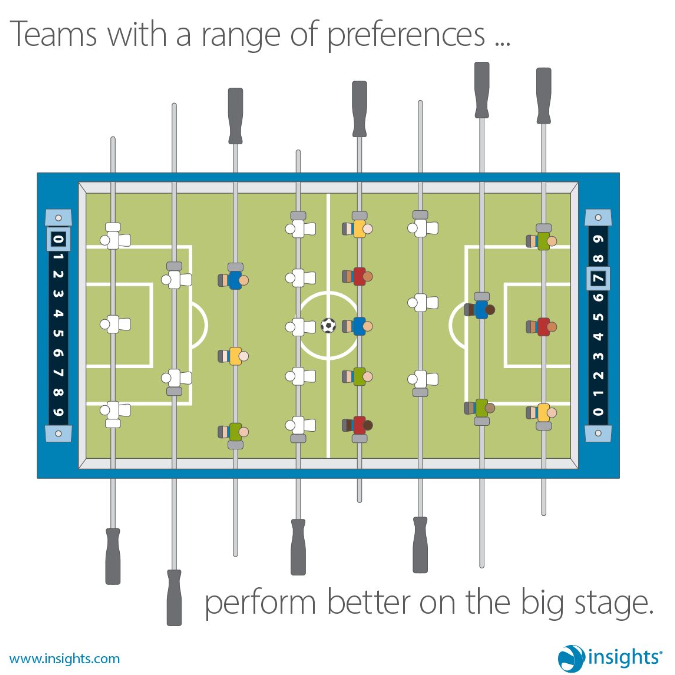
Every team, at some point, hits a wall. Momentum stalls, communication becomes strained, or collaboration that should be straightforward starts to feel like hard work. The challenge is rarely about a lack of effort, it’s usually a lack of shared understanding about what’s getting in the way.
This is where Insights Discovery continues to earn its place beyond the initial workshop. The colour energies give teams a practical lens for recognising the patterns behind their difficulties, and for having more honest conversations about how to address them. If you are looking for Team Building Activities or ideas for a Team Day you can find out more here.
What gets in the way of team effectiveness
Most team challenges fall into a handful of familiar categories. A team lacking focus tends to drift, and the sense of collective purpose starts to erode while accountability becomes unclear. A team that’s lost its flow stops adapting: people find themselves going through the motions rather than engaging critically with the task at hand.
Climate matters too. When trust is low, information gets withheld and people work in silos. Process problems look different but are equally corrosive: unclear priorities, no shared roadmap, and an indifference to deadlines that leaves everyone frustrated.
None of this is unusual. These are the patterns that emerge when teams are under pressure, and recognising which pattern is at play is often the first step towards addressing it.
Seeing challenges through the colour energies
What Insights adds to this is a way of understanding why certain challenges land harder for certain people, and where each person’s natural strengths lie in responding to them.
A team that collectively leans into fiery red energy will feel the absence of accountability and direction particularly acutely, but will also be well-placed to drive momentum once a clear goal is set. A sunshine yellow team will find a closed, stale environment draining, but given space to share ideas and adapt, they’re often the ones who shift the energy in a room. A team with strong earth green energy may absorb tension quietly for longer than is helpful, while those leading with cool blue will feel the friction of a haphazard process more than most. You can see this in action with team building sessions.
The value isn’t in reducing people to a single energy, but in helping a team see where their collective preferences make them more susceptible to certain kinds of difficulty and where they have real strengths to draw on.
Cross-functional friction
One of the more common places this shows up is in cross-functional working. When teams don’t fully understand each other’s roles, priorities, or communication preferences, collaboration becomes effortful. People talk past each other, assume bad faith where there’s simply difference, and protect their own priorities at the expense of shared ones.
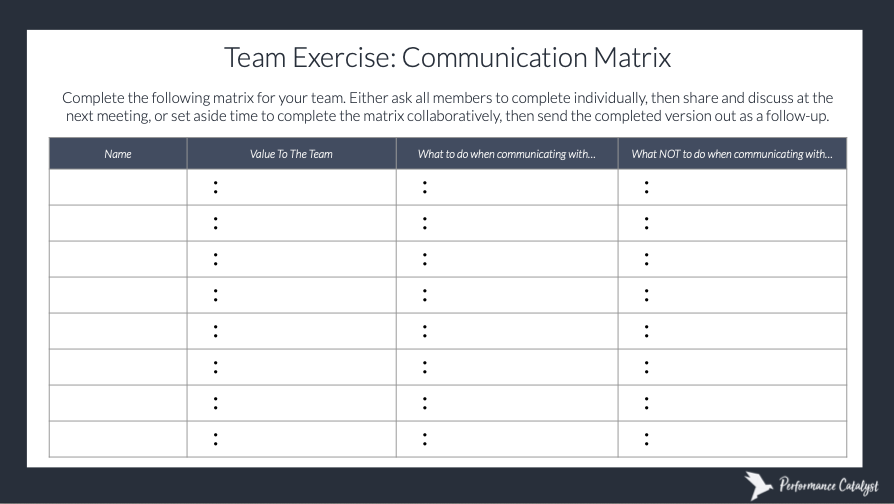
A practical way to address this is the communication matrix – mapping out, for each team member, what works when communicating with them and what doesn’t. It’s a straightforward exercise, but the conversations it generates tend to be genuinely useful. When people understand how a colleague prefers to receive information and what tends to land badly, the friction in joint projects reduces considerably.
What good actually looks like
It’s worth spending as much time on the positive as the diagnostic. Teams with focus hold each other accountable in a way that feels supportive rather than punitive. Teams with good flow keep adapting, share ideas freely, and give people real autonomy to move things forward. This is where team building activities come in handy.
A healthy climate means people feel safe enough to speak honestly, challenge ideas, raise concerns, and support one another without scoring points. Good process means everyone is clear on who does what, decisions are evidence-based, and progress is tracked in a way that keeps everyone oriented.
Insights doesn’t create these conditions by itself. But it gives teams a shared language for discussing them, and that language tends to make the harder conversations more possible.
If you’d like to explore how Insights Discovery could help your team work through a specific challenge, we’d be glad to talk it through.